Tell us about the job
Takes about a minute. No obligation.
A contractor sizing a mini-split for a Wayne County home starts with the structure and the local climate, and the climate here is not the hard variable. 85 severe weather events were recorded in Wayne County, Illinois between 2015 and 2024. At roughly the national midpoint, that rate of severe weather is real but not the dominant pressure on a system's long-term performance. What a properly sized and installed mini-split faces here is mostly the ordinary demand of Illinois summers and winters. A contractor who gets the load calculation right and seals the line set correctly gives the equipment a better foundation than any after-the-fact service can recover.
The electrical service already running through a house decides more about a mini-split installation than the unit itself does. Half the homes in Wayne County, Illinois were built in 1974 or earlier (2020-2024 ACS 5-year). Wiring put in for the appliances and systems of that era was sized to loads that looked nothing like what a mini-split draws today, and a contractor assessing an installation here has to open the panel and work from what is actually there. Ductwork is beside the point for a mini-split, but the electrical is not, and in stock this age that panel is where the job gets priced.
The Mini-split Parts That Go Into an Installation
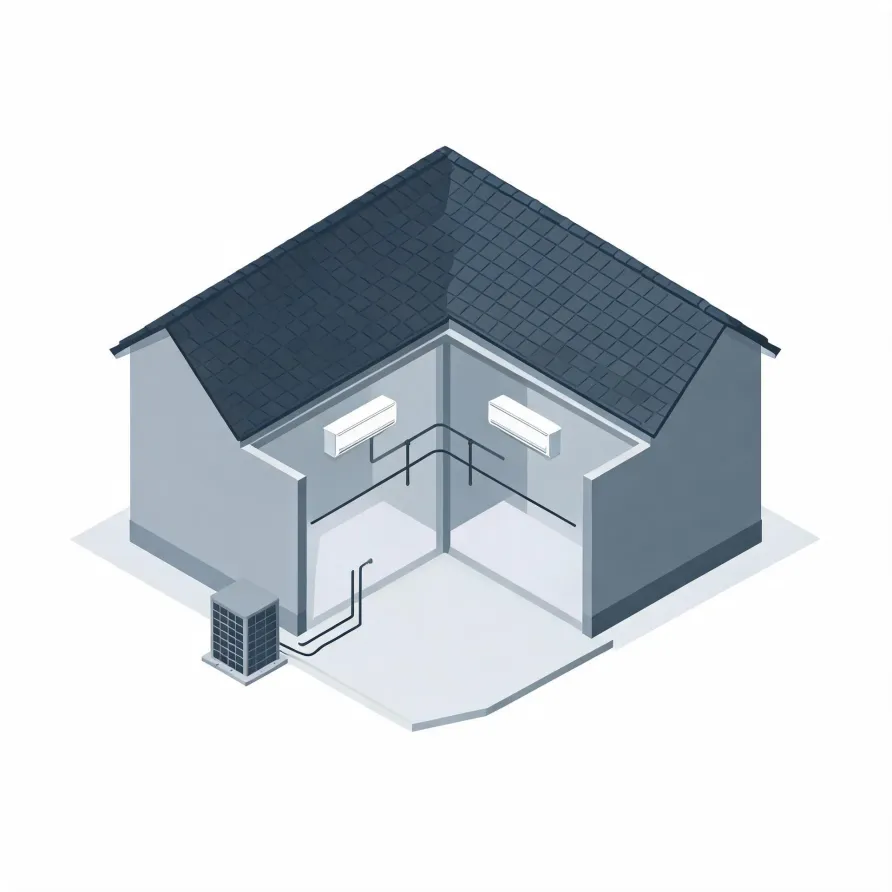
The indoor air handler mounts high on an interior wall, which puts it where conditioned air can reach the room without ducts. Outside the house sits the condenser unit, set on a pad or bracket at ground level or on a wall, and it carries the compressor and the components that drive the whole system.
A refrigerant line set runs through a small hole in the wall to connect the two units, and a condensate drain line carries moisture from the indoor handler to the outside. A dedicated electrical circuit feeds the outdoor unit, and a control wire between the two units lets the thermostat or remote signal the system.
The drawing shows a representative layout, and a licensed contractor determines what the installation looks like in your specific house.
Get matched in Wayne CountyWayne County by the numbers
85 severe weather events were recorded in Wayne County, Illinois between 2015 and 2024.
NOAA National Centers for Environmental Information, Storm Events Database, bulk CSV export, events 2015-01-01 through 2024-12-31.Half the homes in Wayne County, Illinois were built in 1974 or earlier (2020-2024 ACS 5-year).
U.S. Census Bureau, 2020-2024 American Community Survey 5-Year EstimatesWayne County, Illinois holds 7,680 housing units (2020-2024 ACS 5-year).
U.S. Census Bureau, 2020-2024 American Community Survey 5-Year EstimatesOwners occupy 78.4% of the occupied homes in Wayne County, Illinois (2020-2024 ACS 5-year).
U.S. Census Bureau, 2020-2024 American Community Survey 5-Year EstimatesCodes & Standards Behind Mini-Split Work in Wayne County, Illinois1 sourced rules and standards
Licensing and Legal Requirements in Wayne County, Illinois
Illinois leaves HVAC licensing to the municipality: state law lets the corporate authorities of each city or village examine, license and regulate heating, air conditioning and refrigeration contractors, and caps the licence fee they may charge at $50 — so who licenses you depends on the town you work in.
Severe Weather Events in Wayne County by Year
The stress a local climate puts on heating and cooling equipment shapes what a mini-split needs to handle over its life. How often severe weather moves through Wayne County is part of that picture, and it is one reason equipment sizing and installation quality matter here specifically.
85 severe weather events, 2015–2024. Source: NOAA National Centers for Environmental Information, Storm Events Database.