Tell us about the job
Takes about a minute. No obligation.
A contractor diagnosing a mini-split repair in Washington County has to settle one question before anything else: what actually wore this system down. 51 severe weather events were recorded in Washington County, Illinois between 2015 and 2024. At that rate, severe weather shows up here, but it does not define the operating life of a system the way it would in a county where storms are a near-constant condition. Refrigerant lines degrade, capacitors fail, and outdoor units corrode on their own schedule regardless of the weather, and a repair quote that leans on storm load as an explanation deserves a second look.
Older wiring and retrofit refrigerant lines are what a contractor opens into when servicing a mini-split in much of this county. Half the homes in Washington County, Illinois were built in 1972 or earlier (2020-2024 ACS 5-year). A house built for a different generation of heating and cooling often had systems added to it rather than built into it, and that history shows up once the unit comes apart. A refrigerant line routed through a wall that was never meant to hold it, or a circuit that was extended rather than replaced, can change both the scope of the repair and the parts a contractor has to source.
The Parts of a Mini-split a Contractor Checks During Repair
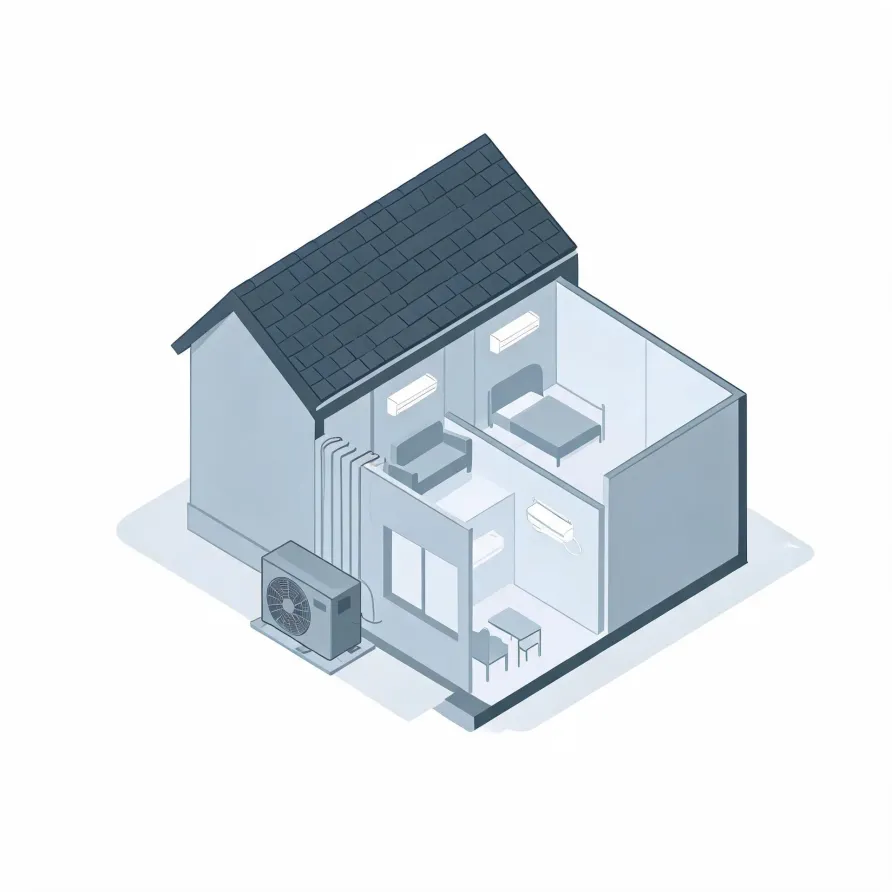
The indoor air handler is the piece most homeowners notice first, mounted high on an interior wall and responsible for moving conditioned air into the room. When a room stops cooling or heating, the handler's fan motor, evaporator coil, and thermistor are among the first things a contractor looks at. The outdoor condenser unit sits outside the home and houses the compressor and condenser coil, both of which are common sources of faults when the system loses capacity or stops responding.
The refrigerant line set runs between the two units, carrying refrigerant through insulated copper tubing, and a leak anywhere along it affects the whole system. The control board, tucked inside the indoor unit, reads signals from the remote and coordinates every function, so a fault there can produce symptoms that look like problems elsewhere. The condensate drain line, which carries moisture out of the indoor unit, causes water damage and shutdowns when it clogs.
The drawing shows the general layout of a mini-split system, and a licensed contractor determines which components are involved based on the specific conditions in your home.
Get matched in Washington CountyWashington County, by the numbers
51 severe weather events were recorded in Washington County, Illinois between 2015 and 2024.
NOAA National Centers for Environmental Information, Storm Events Database, bulk CSV export, events 2015-01-01 through 2024-12-31.Half the homes in Washington County, Illinois were built in 1972 or earlier (2020-2024 ACS 5-year).
U.S. Census Bureau, 2020-2024 American Community Survey 5-Year EstimatesWashington County, Illinois holds 6,415 housing units (2020-2024 ACS 5-year).
U.S. Census Bureau, 2020-2024 American Community Survey 5-Year EstimatesOwners occupy 84.1% of the occupied homes in Washington County, Illinois (2020-2024 ACS 5-year).
U.S. Census Bureau, 2020-2024 American Community Survey 5-Year EstimatesCodes & Standards Governing Mini-Split Repair in Washington County, Illinois1 sourced rules and standards
Contractor Rules in Washington County, Illinois
Illinois leaves HVAC licensing to the municipality: state law lets the corporate authorities of each city or village examine, license and regulate heating, air conditioning and refrigeration contractors, and caps the licence fee they may charge at $50 — so who licenses you depends on the town you work in.
Weather Stress on HVAC Equipment in Washington County
Outdoor conditions put real load on mini-split systems, and the harder a unit works to hold temperature against the weather outside, the more wear it accumulates over time. Repair needs in Washington County track with that workload, which makes local weather history a useful backdrop for understanding why equipment here fails when it does.
51 severe weather events, 2015–2024. Source: NOAA National Centers for Environmental Information, Storm Events Database.