Tell us about the job
Takes about a minute. No obligation.
A mini-split that stops cooling or heating properly in Cumberland County is almost certainly failing for reasons that have nothing to do with the weather outside. 35 severe weather events were recorded in Cumberland County, Illinois between 2015 and 2024. At that rate, severe weather is an occasional event for equipment here, not a steady grind that wears out capacitors or strains refrigerant lines season after season. What a contractor finds instead, when they open a unit that has stopped working, is usually a compressor that has hit the end of its service life, a refrigerant charge that was wrong from the day it was installed, or a component that was never sized correctly for the space it serves.
A mini-split running in a house here was added to that house, not designed into it. Half the homes in Cumberland County, Illinois were built in 1970 or earlier (2020-2024 ACS 5-year). Stock that old was built long before ductless systems existed as a common residential choice, so whatever is behind the walls belongs to a different era than the equipment mounted on them. When a unit opens up, what a contractor is working out is whether the refrigerant circuit, the control board, or the blower assembly is the failure point, and whether the parts that specific model takes are still in production. That answer determines the repair bill far more than anything the house itself is doing.
The Parts of a Mini-split a Contractor Checks During Repair
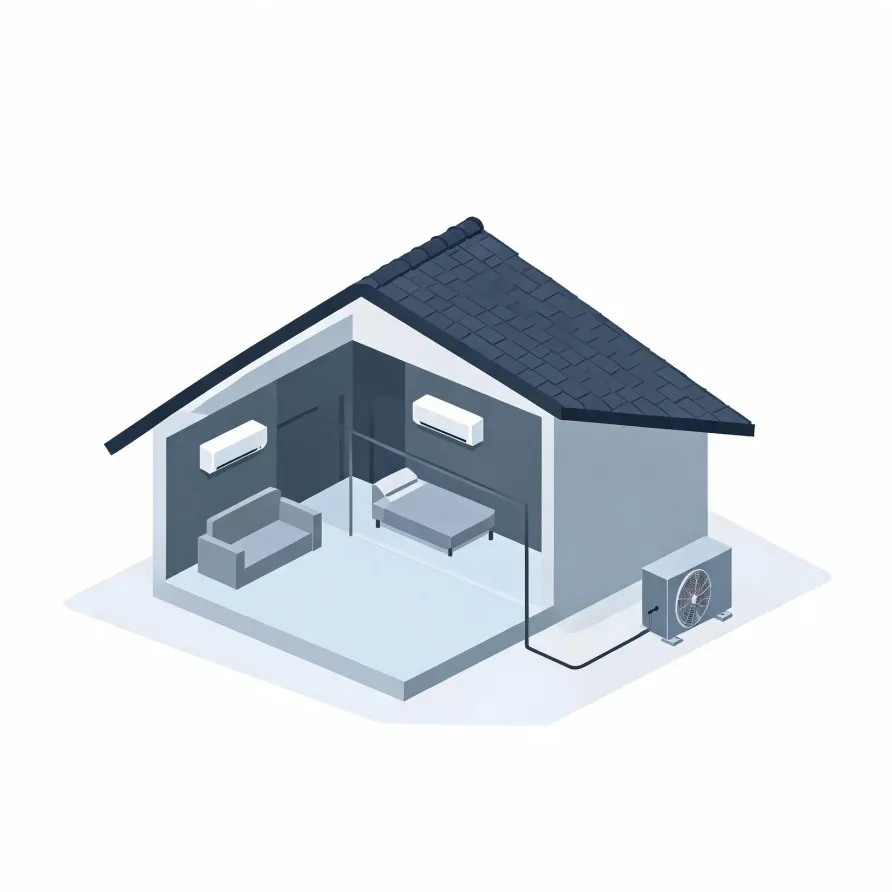
The indoor air handler mounts high on an interior wall and is the piece a homeowner notices first. It pulls room air across a coil and a set of fins, then pushes conditioned air back out. When something is wrong inside the house, this is where a contractor starts: the coil, the fan motor, the drain line, and the sensors that tell the unit what the room is doing.
The outdoor condenser unit sits on a pad or bracket outside and holds the compressor, a second coil, and the fan that sheds heat to the outside air. The refrigerant line set and the control wiring run between the two units through a small penetration in the wall. A fault in the compressor, a refrigerant leak along the line set, or a wiring problem at either end will each stop the system in a different way, so a contractor works through both units before drawing a conclusion.
The drawing shows a typical layout, and a licensed contractor determines what applies to the specific system and installation in your home.
Get matched in Cumberland CountyCumberland County by the Numbers
35 severe weather events were recorded in Cumberland County, Illinois between 2015 and 2024.
NOAA National Centers for Environmental Information, Storm Events Database, bulk CSV export, events 2015-01-01 through 2024-12-31.Half the homes in Cumberland County, Illinois were built in 1970 or earlier (2020-2024 ACS 5-year).
U.S. Census Bureau, 2020-2024 American Community Survey 5-Year EstimatesCumberland County, Illinois holds 4,726 housing units (2020-2024 ACS 5-year).
U.S. Census Bureau, 2020-2024 American Community Survey 5-Year EstimatesOwners occupy 84.2% of the occupied homes in Cumberland County, Illinois (2020-2024 ACS 5-year).
U.S. Census Bureau, 2020-2024 American Community Survey 5-Year EstimatesRepair Rules & Refrigerant Standards Governing Mini-Split Work in Cumberland County, Illinois1 sourced rules and standards
Licensing Rules for Cumberland County, Illinois
Illinois leaves HVAC licensing to the municipality: state law lets the corporate authorities of each city or village examine, license and regulate heating, air conditioning and refrigeration contractors, and caps the licence fee they may charge at $50 — so who licenses you depends on the town you work in.
Severe Weather Events in Cumberland County
Weather stress is a direct load on heating and cooling equipment, and Cumberland County's climate shapes how hard local systems work and how often they need attention. A mini-split that runs under pressure year after year faces repair demands that are specific to this place.
35 severe weather events, 2015–2024. Source: NOAA National Centers for Environmental Information, Storm Events Database.